Most wood guides are written by people selling you one wood. This one is written by two brothers who build all six, which means we genuinely don't care which one you pick — we care that the drum sounds like what you heard in your head.
So before anything else: a snare's voice is mostly the player, then the tuning, then the heads, then the shell. Anyone who tells you the wood is the whole story is selling wood. What the shell does is set the character the rest of your choices happen inside. It's the room the sound lives in, not the sound.
That said, the room matters. Here's what each one does.
First, why staves
Solid wood. Standing up.
A stave shell is built like a barrel — individual strips of solid hardwood, standing vertically, joined edge to edge and turned round. Most drums aren't built this way. Most drums are plywood.
A ply shell is thin sheets of wood wrapped horizontally around a mold, with glue between every layer. It works, it's consistent, and it's how the vast majority of snares on every stage tonight were made. No shame in it.
But every glue line is a small piece of the shell that isn't wood. It's a boundary the vibration has to cross, and glue doesn't resonate — it damps. Stack seven of them and you've built a shell that's part instrument, part adhesive.
A stave shell has vertical joints between solid pieces, and no horizontal layers at all. Which means two things. Less glue in the vibrating path — more of the shell is actually wood doing what wood does. And the bearing edge lands on end grain, cutting across the fibers rather than along them, so energy from the head transfers straight down through the length of the wood instead of across it.
The practical result is a shell with more of its own opinion. Longer sustain, more projection, and a wood character that's actually audible instead of theoretical. That's the upside. The honest downside: staves are slower to build, they cost more, and they're less forgiving of a bad tuning job. A stave drum will tell on you.
It also means the wood choice below matters more on a stave drum than it would on a ply drum. On seven plies of glue and veneer, the difference between cherry and walnut is a rumor. On a stave shell, it's a decision.
Start here
Start with the sound, not the wood.
Nobody actually wants cherry. They want a snare that doesn't disappear under two guitars. Work backwards from the sound and the wood picks itself.
Balanced and versatile, with a warm fundamental and a focused attack.
Rock & popAnything and everything14×6 is the sweet spot$800–1,200
Maple is the default, and default isn't an insult. It's the wood that doesn't argue with anything. Warm underneath, focused on top, and even enough across the frequency range that it sits in a mix without a fight.
If you play four different styles in a week — Sunday morning, a bar gig Friday, a session Tuesday, a rehearsal in between — maple is the drum that shows up for all four without complaining. It's not the most exciting answer. It's the one people keep for twenty years.
Where it's not the answer: if you already know exactly what you want and it's a specific extreme — very dark, very dry, very loud — maple will give you a good version of it and another wood will give you a great one.
Consider instead: Walnut, if you want more warmth and dark complexity than maple's neutrality gives you.
Birch
Punchy and dry, with natural attack up top — pre-EQ'd for the mix.
Studio & session14×6$800–1,200
Birch does something engineers have been chasing with EQ for fifty years: it arrives with the top end already lifted and the sustain already controlled. That's not marketing — it's why birch became the studio wood in the first place.
The practical version: you put a mic on a birch snare and there's less to fix. Less ring to gate, less mud to carve, less top end to add back. It's punchy, it's dry, it gets out of its own way.
The tradeoff is that "controlled" and "exciting" are close cousins. Birch behaves. If you want a drum that surprises you in the room, birch isn't chasing that — it's chasing the thing that sounds right on playback.
Consider instead: Maple, if you want to trade some of that studio dryness for versatility.
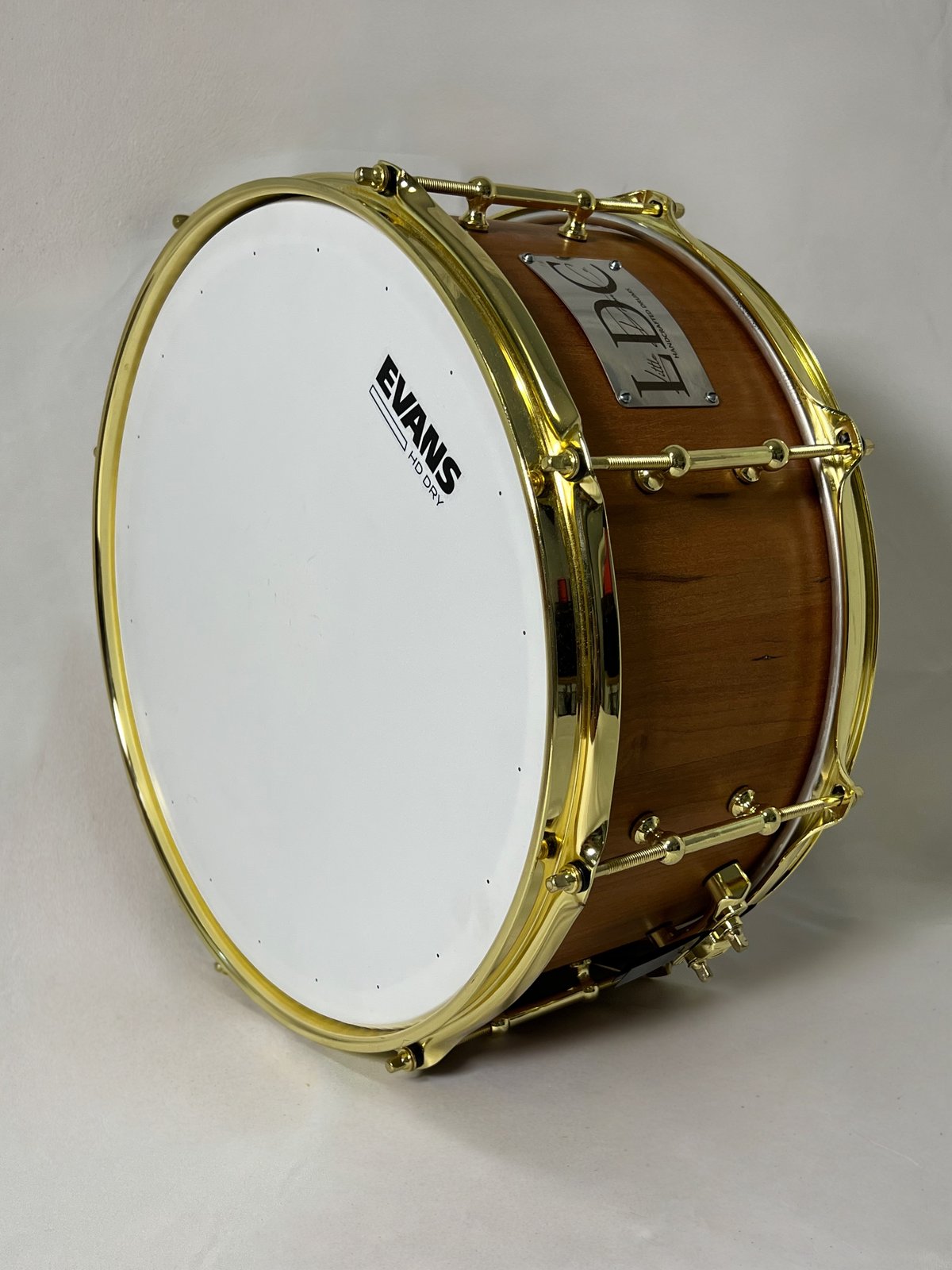
Cherry
Bright and clear, with a musical high-end that cuts without ever getting harsh.
Gospel & funkCrack & articulation14×5.5 or shallower$800–1,200
Here's the distinction that matters, and most people get it wrong: bright is not the same as harsh.
Plenty of drums get loud in the top end by getting ugly there — that ice-pick 4k spike that makes a snare "cut" by making it unpleasant. Cherry doesn't do that. It's genuinely bright, genuinely clear, and the high end it produces is musical — it sits up above the guitars without ever turning into a complaint.
That's why it's our gospel and funk answer. Those players live on ghost notes and rimshots in the same bar, and they need a drum where the quiet stuff is audible and the loud stuff doesn't hurt. Cherry does both.
Go shallow with it. Cherry at 5.5 or less is where the articulation lives; adding depth to a cherry drum is working against the thing you picked it for.
Consider instead: Maple, if you want the same articulation with more balance across all frequencies.
Mahogany
Deep and warm, with a big, full low-end that sits under vocals beautifully.
Church & worshipWarm & fat14×7$800–1,200
Mahogany is our worship answer, and the reason is in the phrase "sits under vocals." That's the entire job.
A worship drummer isn't trying to be heard — they're trying to hold up a room full of people singing. The snare has to be felt on two and four without ever competing with the thing everybody actually came for. Mahogany's low end is big and full without being loud in the frequencies where a voice lives. It supports instead of intrudes.
It's also the general warm-and-fat answer for anyone, regardless of what you play. If the sound in your head is round and thick and forgiving, this is the shell.
We build these deep. 14×7 is where mahogany makes sense — the wood and the depth are doing the same job, and it'd be strange to pick mahogany and then fight it with a shallow shell.
Consider instead: Walnut, if you want the warmth but with more focus and less low-end sprawl.
Walnut
Warm and dark, with complex overtones — the connoisseur's wood.
Jazz & R&BIndie & singer-songwriter14×5.5 to 14×6$800–1,200
Walnut is the one we'd pick for ourselves, and we're aware that's not a neutral thing to say.
It's warm and it's dark, but the word that matters is complex. Where maple gives you a clean fundamental and gets out of the way, walnut gives you a fundamental plus a cloud of overtones underneath it that move as you play. Softer, you hear one thing. Harder, you hear another. It's a drum that responds to touch rather than just volume.
That's why it's the jazz and R&B pick, and why it works for indie and singer-songwriter material too — quiet music where the snare has to be interesting at low volume, not just present at high volume.
The odd exception worth naming: walnut is also our warm-and-fat answer for metal players. Mahogany is the usual warm answer, but under that much gain, mahogany's low end disappears into the guitars. Walnut's focus survives it.
Consider instead: Mahogany, if you want even more warmth and low-end body.
Oak
Loud and aggressive, with powerful projection that cuts through anything.
Metal & hard rockLoud & cutting14×6.5 and up$800–1,200
Oak is dense and hard and it does not care about your feelings. It's the loudest shell we build, and it projects in a way the others don't — the sound arrives at the back of the room roughly intact.
This is the metal and hard rock answer for an obvious reason: when you're up against two downtuned guitars and a wall of gain, "musical" is a luxury and "audible" is the requirement. Oak is audible.
Give it depth. Oak at 6.5 or deeper keeps the aggression but puts a body underneath it, so you get a drum that cuts and has weight rather than one that's just sharp.
The honest caveat: oak is not subtle, and it doesn't reward a light touch the way walnut or cherry do. If half your playing is quiet, this is the wrong shell for that half.
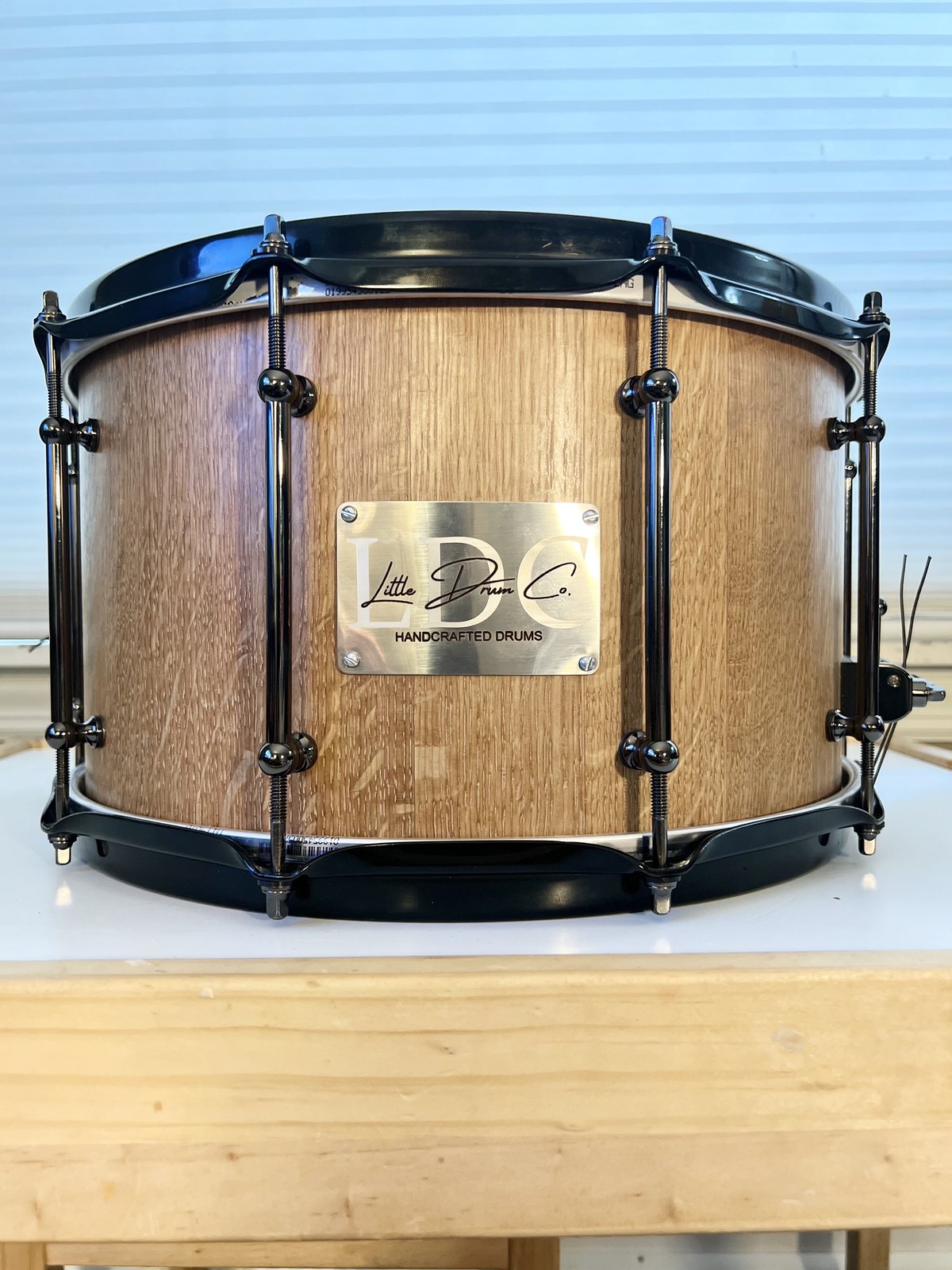
Quartersawn oak — the flecking is the wood's medullary rays, cut across. Reserve Series.
Consider instead: Birch, if you want the projection but with more studio friendliness.
The other half
Depth is half the decision.
Everyone agonizes over wood and then picks a depth in four seconds. It's roughly a 50/50 split, and depth is the one you'll notice first.
3.5–5″
Crack and speedPiccolo territory. Fast response, maximum articulation, ghost notes that actually speak. Very little body underneath — this is a drum that says one thing and says it immediately.
5.5″
Articulate, with just enough underneathWhere we cap it for anyone chasing crack. You keep the response and the sensitivity but get a little weight behind the backbeat. Our cherry and jazz-walnut depth.
6″
The middle, and the safest betIf you don't know, it's this. Enough body to feel substantial, enough response to play quietly. Most drums that get kept for decades are 6″.
6.5″
Body and volumeThe floor for anything loud or fat. You're trading a little sensitivity for a lower fundamental and more air moved per hit.
7–8″
The worship depthBig, low, and loud without hitting harder — which is the whole trick. You get presence at a volume that doesn't run over the room. Our worship drummers love 14×7 and we've gone to 14×8. Ghost notes suffer; you're not buying it for ghost notes.
Reserve Series
Same voice. Better grain.
Figured wood is the same species with an unusual grain pattern — an accident of how the tree grew. It looks extraordinary. It sounds like the wood it is.
We'll be straight with you, because this is where the industry usually isn't: figured wood doesn't sound better. Curly maple is maple. It has maple's voice, maple's response, maple's everything. What it has instead is grain that moves when you move — figure that catches light and looks like water under the finish.
You're buying it because it's beautiful and because there isn't another one like it. That's a completely good reason. It just isn't a tonal one, and anybody telling you otherwise is charging you extra for a story.
Which figure exists depends on the species — you can't order birdseye cherry, because cherry doesn't grow that way. Here's what's actually available:
Maple
Curly, Birdseye, Quilted, Flame
Cherry
Curly only — cherry doesn't produce the others
Walnut
Curly, Claro, Burl
Mahogany
Pommele, Ribbon
Birch
Curly, Flame
Oak
Quartersawn, Fiddleback
Reserve Series builds start at $1,200 and run up depending on the figure and the size of the board it came off.
Exotics
When you want the only one.
Purpleheart. Bloodwood. Bocote. Bubinga. Lacewood. Leopardwood. Dense, dramatic, and expensive for real reasons — the lumber costs what it costs, and it fights back on the lathe.
Exotic builds start at $3,000. If that's where you're headed, talk to us before you fall in love with a photo — some of these behave very differently under a stick than they look on a screen.
Still deciding
Talk it through with Kit.
Two questions — what you play, and what you're chasing — and Kit will narrow this whole page down to one drum. Takes about a minute. He'll pass it to us with a quote inside 24 hours.